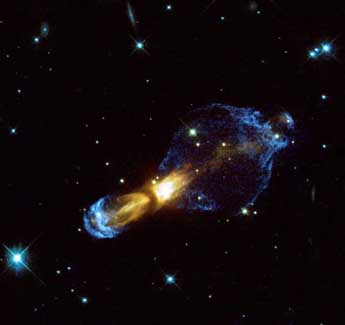
The Making of the Rotten Egg Nebula
Fast expanding gas clouds mark the end for a central star in the Rotten Egg Nebula.
The once-normal star has run out of nuclear fuel, causing the central regions to contract
into a white dwarf. Some of the liberated energy causes the outer envelope of the star to expand.
In this case, the result is a photogenic proto-planetary nebula. As the million-kilometer
per hour gas rams into the surrounding interstellar gas, a supersonic shock front forms
where ionized hydrogen and nitrogen glow blue. The complex shock front had been hypothesized
previously but never so clearly imaged. Thick gas and dust hide the dying central star.
The Rotten Egg Nebula, also known as the Calabash Nebula and OH231.8+4.2, will likely develop
into a full bipolar planetary nebula over the next 1000 years. The nebula, pictured above,
is about 1.4 light-years in extent and located about 5000 light-years away toward the
constellation of Puppis.