Zooming in on the First Stars
What became of the first stars? No known stars appear to be composed of
truly primordial gas -- all of the stars around us have too many heavy
elements. Our own Sun is thought to be a third generation star, with many
second-generation stars seen in globular clusters. This year, however,
significant progress is being made on solving this perennial astronomical
mystery. Analyses of recent WMAP satellite images of the cosmic microwave
background indicate that this primordial light was ionized by a first
generation of stars that came and went only 200 million years after the
Big Bang. Additionally computer codes are now more-accurately tracking the
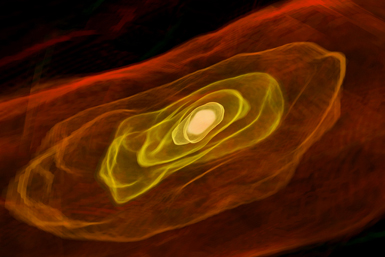
likely creation and evolution of first stars in the early universe. Pictured
above at a scale of one light-month, a computer-generated model resolves the
scale of the first stars, indicating clean cocoons that condensed into stars
always over 30 times the mass of our Sun. Stars like this quickly fused pristine
gas into heavier elements and then exploded, seeding the universe with elements
that would become part of the stars we know and, ultimately, ourselves.