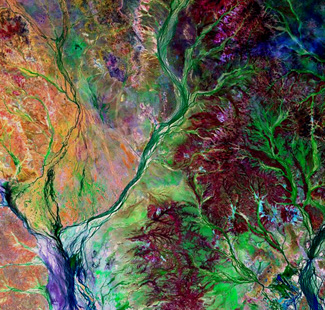
Channel Country, Queensland, Australia
Geologists refer to the 1.3-million-square-kilometer (500,000-square-mile) region in
southwestern Queensland, Australia, as "Channel Country." The name derives from the
complex network of riverbeds and streams coursing through the relatively flat terrain,
made mostly of clay. The portions of the Burke and Hamilton Rivers shown in this
false-color satellite image are typical of the branching outflow patterns (called
alluvial fans) commonly found in Channel Country.
The image shows an area where rivers emerge from highlands surrounding the Lake Eyre
drainage basin. Weather patterns over these highlands vary through the seasons.
Winters are generally very dry, while the air in summertime becomes much more humid,
bringing monsoon rains like those found in the tropics. Annual rain accumulation
reaches about 50 cm (20 inches) in the Great Dividing Range, situated to the east
of this scene. The rains come in intermittent bursts and so the streams shown in
this scene are short-lived, flowing only in discreet flood seasons that are separated
by long droughts. Between flows, water collects and forms pools only in the deeper
channels. Such pools are critical elements in the ecosystem and in the grazing
economy. The Channel Country rivers lose water gradually through evaporation and
infiltration as they flow toward the Lake Eyre basin.
|