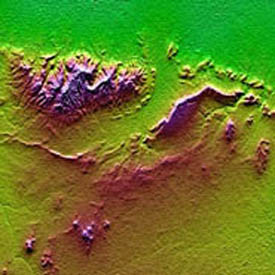
Topography: Haro and Kas Hills, India
On January 26, 2001, the Kachchh region in western India suffered the
most deadly earthquake in India's history. This shaded topography view of
landforms northeast of the city of Bhuj depicts geologic structures that are of interest
in the study the tectonic processes that may have led to that earthquake. However,
preliminary field studies indicate that these structures are composed
of Mesozoic rocks that are overlain by younger rocks showing little deformation.
Thus these structures may be old, not actively growing, and not
directly related to the recent earthquake.
The Haro Hills are on the left and the Kas Hills are on the right. The Haro Hills are an "anticline,"
which is an upwardly convex elongated fold of layered rocks. In this view, the anticline
is distinctly ringed by an erosion resistant layer of sandstone. The east-west orientation
of the anticline may relate to the crustal compression that has occurred during India's
northward movement toward, and collision with, Asia. In contrast, the largest of the Kas Hills
appears to be a tilted (to the south) and faulted (on the north) block of layered rocks.
Also seen here, the linear feature trending toward the southwest from the image center
is an erosion-resistant "dike," which is an igneous intrusion into older "host" rocks
along a fault plane or other crack. These features are simple examples of how shaded
topography can provide a direct input to geologic studies.
In this image, colors show the elevation as measured by the Shuttle Radar Topography
Mission (SRTM). Colors range from green at the lowest elevations, through yellow and red,
to purple at the highest elevations. Elevations here range from near sea level to about 300 meters.